Showing posts with label dad. Show all posts

The Four Feathers (1939) Review

The Four Feathers (1939)
Average Reviews:

(More customer reviews)
Thank god I gave this movie another chance! A few years ago I watched this film on a local public television station. The print they showed, however, was old and worn, with hundreds of lines and specks marring every scene. Also, the color was so badly faded that it almost looked like it was filmmed in black and white.
But reviewing the film on a newly restored and enhanced print was nothing short of a revelation. It was frequently gorgeous to look at, and the high quality of the print allowed me to focus on the story. Many of the scenes were filmmed on location in the Middle East, which greatly added to the appeal of the movie (in American epics of the thirties, even the Crimea and India ended up looking like the Mojave Desert for obvious reasons--reminds me of the funny scene in the second Austin Powers movie, where Austin casually remarks while driving down a road that is clearly on the California coast, "Isn't it amazing how much the coast of England looks like California?").
In 1939, the British film industry still lagged far behind the American film industry in technical proficiency. Alfred Hitchcock, who left England in 1940 to work in the US for the next 25 years, managed to succeed despite the studio shortcomings, but even in his British films of the thirties the gap in sound and basic photographic techniques is all too apparent as we watch the films of that time. One of the great achievements of Producter/Director Alexander Korda (his brother Zoltan directed THE FOUR FEATHERS while Alexander produced and owned the studio that made the film) was making the first films in Great Britain that rivaled the technical (as opposed to cinematic) accomplishments of Hollywood. THE FOUR FEATHERS holds up admirably with most of the big budget films made in Hollywood in 1939. The color is perhaps not as vivid as in GONE WITH THE WIND or THE WIZARD OF OZ, but it nonetheless is quite good for the time. And this film is thoroughly convincing as an epic. Thousands and thousands of extras were used, but unlike Hollywood, where whites were made up to look like Native Americans, Asian Indians, or Arabs, the extras in THE FOUR FEATHERS clearly hailed from one or another part of Africa or the Middle East.
The cast is solid, but two performances stand out. C. Aubrey Smith made a career out of playing bombastic and self-important British Colonels or Generals. And he never performed that role better than in this film. But the best performance was by the always spectacular Ralph Richardson (does anyone else find a stunning physical resemblence between him and Kevin Spacey?). No one ever stole a scene from Ralph Richardson. Even in small roles he could dominate the action. Tragically, his film opportunities rarely took advantage of his gigantic talent. His technique and voice were the equal of Olivier and Alec Guinness, yet he never quite matched their film success. He did, however, manage to excell on the stage. In this regard, Richardson's career mirrored that of John Gielgud, whose screen career was equally paltry compared to his stage successes. Apart from THE FOUR FEATHERS, my favorite Ralph Richardson performances are an amazing film version of A LONG DAY'S JOURNEY INTO NIGHT and Q PLANES (AKA CLOUDS OVER EUROPE). His character in the latter was the direct inspiration for "John Steed" in THE AVENGERS on TV in the sixties.
Now for the scary news. This marvelous film is being remade starring Heath Ledger (from A KNIGHT'S TALE--medieval history reborn as an MTV inspired movie) in the Ralph Richardson role and Wes Bently (from AMERICAN BEAUTY) in the John Clement role. Kate Hudson from ALMOST FAMOUS takes the female lead.

Click Here to see more reviews about: The Four Feathers (1939)


Buy Now

Click here for more information about The Four Feathers (1939)

Read More...

K-19: The Widowmaker (2002) Review

K-19: The Widowmaker (2002)
Average Reviews:

(More customer reviews)
This exceptional film is inspired by tragic historical events. The screenplay is a composite, based equally on two separate Soviet naval disasters. The first, obviously, is the 1961 "cursed" maiden mission of K-19, Russia's pioneer nuclear-powered ballistic missile submarine. The second is a narrowly-averted catastrophe of 1986, involving the decrepit "Yankee-class" boomer, K-219. Ironically, the movie was also nearly scuttled -- before it even began production. The rough draft contained every Slavophobic stereotype and Cold War cliche', and was bitterly protested by K-19's surviving officers. They wtote a series of open letters to the producers and actors, inviting them to Russia to hear their real story. When director Katheryn Bigalow met these aging veterans and the widow of their recently-deceased Captain, she resolved to film a tribute to their courage. Much of the film's reference material comes from two superb books written by Capt. Peter Huchthausen USN-ASW (ret.): "K-19: The Widowmaker"; and "Hostile Waters". The former contains the translated memoir of Captain Nikolai Zateyev (real-life CO of the ill-fated sub) with an addendum about the film. The latter, co-authored with Capt. Igor Kurdin and novelist Robin White, tells the amazing story of K-219. I urge viewers to read both books for an even greater appreciation of the movie! You'll see that Harrison Ford is a dead-ringer for Zateyev, both physically and personality-wise. He commands the role of Vostrikov (Zateyev) to perfection. Liam Neeson's character, Capt. 2nd Rank Polenin, appears strongly based on K-219's Captain Igor Britanov, who was the compassionate father-figure popular with his crew. The Captains' contrasting styles of leadership provide the conflict in the film. Hollywood melodramatization is apparently obligatory, even when true events provide drama aplenty. The mutiny's only basis in reality concerned a dispute over whether to head the stricken K-19 for a Norwegian port or toward the last-known operational area of Soviet diesel submarines. A core meltdown, while not producing a "thermonuclear explosion", would have released a massive cloud of atomic contamination. K-19's disaster occurred far from any American interests, but K-219's runaway reactor threatened to dust the entire Eastern Seaboard with lethal plutonium. K-19's valiant third-watch did cobble together a makeshift cooling system in just the manner depicted. A fire did break out. And K-19's men suffered horrifying radiation poisoning within the core so hot as to boil their bodily fluids. But the character of Vadim Rodchenko, the young Reactor Officer who conquers paralyzing fear, clearly honors the memory of another engineer. K-219's Seaman Sergei Preminin manually shut down his overheating reactor, sacrificing his life to save Americans from a Chernobyl-in-a-tin-can mere miles off our coast. It was K-219's Britanov who defied Moscow's orders to halt evacuation, and decided to sink his sub to deprive the circling enemy of its prize. And although K-19's crew was absolved of blame and even decorated for their actions, K-219's Catain and officers were persecuted by the unforgiving Soviet system depicted in the film. Thus, while "K-19: The Widowmaker" is not entirely true to its namesake, it accurately portrays the life-and-death scenario which repeatedly plagued the USSR during the Cold War. In its desperation to play "catch-up" with its vastly superior American counterpart, the Soviet Navy would continue to risk its young submariners in hastily-designed, shoddily-built, or outright obsolete boats. Katheryn Bigalow and National Geographic deserve credit for showing the American audience the human side of these young seamen and officers who were just as gallant, dedicated, and patriotic as our own. We care about them, salute their heroism, and mourn their loss. "K-19" is visually magnificent and emotionally compelling. An absolutely spellbinding drama. You'll want the video, but see the film today before it leaves the Big Screen!

Click Here to see more reviews about: K-19: The Widowmaker (2002)

K-19: WIDOWMAKER - DVD Movie

Buy NowGet 15% OFF

Click here for more information about K-19: The Widowmaker (2002)

Read More...

Twelve O'Clock High (1950) Review

Twelve O'Clock High (1950)
Average Reviews:

(More customer reviews)

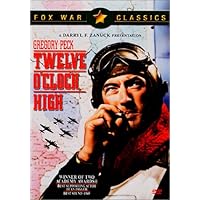
I do not recall another film whose opening and closing scenes are more effective than those in this brilliant portrayal of the 918th Bombardment group based in England which flew almost daily missions to Germany during World War II. The character of General Frank Savage (Gregory Peck) is reputedly based on Brigadier General Frank A. Armstrong, Jr. Sy Bartlett co-authored the screenplay with the book's author, Berney Lay, Jr. Brilliantly directed by Henry King, we are introduced to a combination of combat fatigue and self-pity which results in the replacement of Colonel Keith Davenport (Gary Merrill) by his friend Savage who is told by his commanding officer, General Pritchard (Millard Mitchell), to shape up the 918th while avoiding Davenport's problem: Becoming overly involved emotionally in decisions to send B-17 crews on exceptionally dangerous missions, day after day after day. Savage immediately establishes his authority and almost immediately loses whatever goodwill he may have had. He applies and then maintains constant pressure on the crews to improve their performance in all areas of flight operations. Underachievers are reassigned to one B-17 renamed "The Leper Colony." Morale deteriorates to such a point that those at headquarters become concerned. A formal investigation of the situation is conducted. This is a critical moment for Savage. If he has "lost" his men, he cannot continue. In fact, he expects to be relieved and begins to pack his personal items. However, for reasons best revealed in the film, Savage remains in command. And then....
It would be a disservice to those who have not as yet seen this film to say any more about the plot. Suffice to say that brilliant direction, great acting by everyone involved (notably by Dean Jagger who received an Academy Award for best actor in a supporting role), superb cinematography (Leon Shamroy), and haunting music (Alfred Newman) are seamlessly integrated in this analysis of effective leadership (especially decision-making) under wartime conditions. The film begins when Harvey Stovall (Jagger) makes an especially significant purchase in an antique store and then proceeds to what has by then become an abandoned air base. As we begin to hear the bombers' propellers whine as the engines roar to life, we are transported back in time. Later, as the film ends, civilian Stovall climbs back on his rented bike and departs what is again an abandoned air base. Stunning images throughout both sequences.
Peck included this among his favorite films, while adding that he was especially proud of his performance as Frank Savage. When first released more than 50 years ago, it did not receive the recognition (much less the appreciation) it so obviously deserves. Whenever CEOs and other senior-level executives ask me to suggest war films which offer important lessons about leadership and management, Twelve O'Clock High is first on the list, joined by (in alphabetical order) Command Decision, The Dirty Dozen, The Enemy Below, Fort Apache, The Hunt for Red October, Paths of Glory, Pork Chop Hill, The Red Badge of Courage, They Were Expendable, and Zulu.

Click Here to see more reviews about: Twelve O'Clock High (1950)

This gritty World War II action drama staring Gregory Peck, Oscar winner Dean Jagger, Hugh Marlowe, Gary Merrill and Millard Mitchell is seen as one of the most realistic portrayals of the heroics and perils of war. Convinced an air force commander (Gary

Buy Now

Click here for more information about Twelve O'Clock High (1950)

Read More...