Showing posts with label 1943. Show all posts

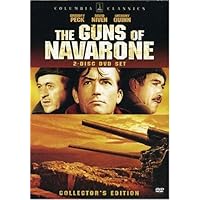
The Guns of Navarone (Collector's Edition) (1961) Review

The Guns of Navarone (Collector's Edition) (1961)
Average Reviews:

(More customer reviews)
The second movie in Columbia's newest wave of World War II movies (along with "The Caine Mutiny") is the 1961 Academy Award-winning film for Best Special Effects, "The Guns of Navarone," which stars Gregory Peck as Keith Mallory, the leader of a group of British commandos tasked with destroying two gigantic German anti-ship guns.
The British are desperate to evacuate 2,000 soldiers from the Aegean island of Kiros, with the only sea route through a stretch of water commanded by the guns that are encased inside a massive cliffside bunker that is immune to air attack.
Based on the best selling novel by Alistair (Where Eagles Dare) MacLean, Mallory has been working on occupied Crete for two years and as an expert mountaineer is the perfect choice to ferry the team to the only part of Navarone not monitored by the Germans - a 400-foot cliff.
Joining Peck is David Niven as explosives expert John Anthony Miller and Anthony Quinn as a Greek resistance fighter.
MacLean is known for being able to weave together a great story and this movie is consistently entertaining. In fact the film was already afforded a respectable special release on DVD in 2000. Columbia though have outdone themselves with this 2-disc set by adding a second audio commentary and four new documentaries.
The original release included a rather dry, faltering, but informative commentary by director J. Lee Thompson, a smattering of archival featurettes of varying quality and an anecdotal documentary on the making of the picture featuring on-camera interviews with Gregory Peck, Anthony Quinn, James Darren and J. Lee Thompson named "Memories of Navarone" and running at 29:34. It's a nice, breezy documentary and entertaining - detailing some of the experiences the cast had working on the picture.
However this new release includes a lively commentary with historian Stephen J. Rubin who mentions that this film started the trend of Hollywood going outdoors. Up until this time most movies were filmed on the studios backlot, whereas this movie was filmed on the island of Rhodes. He also discusses the cast (including a very young Richard Harris). Rubin also discusses some of the differences between the MacLean novel and the movie - which appear to be a number of changes to characterization and details some of the criticisms of the movie when it was released - including the fact that the actors were too old to play commando's, many being as they were in their 40s and 50s. Though Rubin quickly adds that he feels it was cast perfectly.
Also included are two new documentaries, the first of these "Forging the Guns of Navarone" runs at 13:58 and includes on camera interviews with Eve Williams-Jones (the former wife of producer Carl Foreman) and Assistant Director Peter Yates (who himself went on to become a very successful director in his own right). Apparently Thompson was not the original director for the project and Yates credits Thompson for his ability to jump straight into a film that had already shot much of its second unit work as well as his ability to manage so many big name actors. Yates also reveals that despite their on-screen animosity towards each other, both Niven and Peck got along well together determined to have as much fun as possible on the picture. Yates also recounts how the crew would refer to it as "The biggest B-feature ever made."
The second new documentary "The Ironic Epic of Heroism" runs longer at 23:38 and is essentially an on-camera analysis of the movie by noted Film Historian Sir Christopher Frayling (who was mistakenly credited with providing an audio commentary in the press release for this DVD release). Frayling is quite engaging as he recounts such facts as Foreman's initial reluctance to handle the project. Foreman once said that he was incapable of making a movie that did not make statements and he initially saw the MacLean book as a simple action adventure. It was not until he re-read the novel that he realized it could serve to make statements about the futility of war and the ability of war to bring out the best in people.
Frayling also reflects on the fact that the movie was the first global production caper-style World War II movie to be played as an action adventure in a style he describes as "incredibly innovative."
Also included on this new release is the restored intermission with score that was seen in some European cities (it is listed as an extra since it is not part of the official cut of the movie) and featurettes on the Dimitri Tiomkin score which details the subtle differences throughout the movie and a fascinating look at the UCLA restoration.
The restoration featurette details the tortured path towards restoring a film that was in such terrible shape that they needed several sources of original negative, both from Columbia and a private collector. In an example of the work the UCLA team had to do, the print they were provided by Columbia had the plane crash at the beginning of the movie happen in broad daylight. This apparently is how most people have seen the scene in recent years. That was until one of the eagle-eyed team at UCLA noticed that one of the trucks had it's headlights on and wondered why. Sure enough they were able to track down a copy of the print from a private collector that showed that the crash happened at night with the screen various shades of blue - and that is how it was restored.
In another instance the print UCLA had also had the infamous dubbing of Richard Harris where the censor had the word "bloody" replaced with "ruddy" for some of the screenings in the UK (the word "bloody" is considered a swear word in the UK). The UCLA team prevailed again and were able to locate a copy of the correct audio still intact).
On a sidenote the DVD also affords fans of Tiomkin the opportinity to hear the opening sequence sans the narrative as a special feature on the second disc. This apparently is a special feature that had been requested for years.

Click Here to see more reviews about: The Guns of Navarone (Collector's Edition) (1961)

Gregory Peck, Anthony Quinn and David Niven are Allied saboteurs assigned an impossible mission: infiltrate an impregnable Nazi-held island and destroy the two enormous long-range field guns that prevent the rescue of 2,000 trapped British soldiers. Blacklisted screenwriter Carl Foreman (High Noon,The Bridge on the River Kwai) was determined to re-establish both his name and credibility after spending most of the 50's working in anonymity. To accomplish this, he decided to bring Alistair MacLean's best-selling novel, The Guns of Navarone, to the screen. Supported by an all-star cast and produced on a grand scale, the film was an enormous success, receiving seven 1961 Academy Award® nominations (including Best Picture) and winning for Best Special Effects. Although Foreman achieved his goal, it was MacLean who would wind up the true beneficiary; his novels became the source for many high adventure screen epics, including Ice Station Zebra and Where Eagles Dare. However, it is The Guns of Navarone that remains not only the best of the MacLean adaptations, but one of the greatest action/adventure spectacles ever produced.

Buy NowGet 10% OFF

Click here for more information about The Guns of Navarone (Collector's Edition) (1961)

Read More...

Uprising (2001) Review

Uprising (2001)
Average Reviews:

(More customer reviews)
"Uprising" is a story of the Holocaust that really could not be told until NBC showed this two-part made-for-television movie in 2001. The story of the Warsaw ghetto uprising has been told before. In the 1978 mini-series "Holocaust," a major subplot had to do with Moses Weiss (Sam Wanamker), who becomes active in the uprising before being caught and shot by the Nazis at the end. Other movies dealing with the Holocaust have touched on this heroic but futile act of resistance against Hitler's army. This time, however, the point is to cast the uprising in terms that count for more than a moral victory.
When Poland fell to Nazi Germany the city's Jewish population was put into a walled in section of the city, thereby creating the ghetto. In the summer of 1942, after 300,000 Jews were deported from Warsaw to Treblinka the first reports of mass murder were heard in the Warsaw ghetto. Mordecai Anielewicz, then 23-years-old, and other young Jews formed the Zydowska Organizacja Bojowa (Jewish Fighting Organization), issuing proclamations calling for the Jewish people to resist being sent away in railroad cars to the death caps, and firing upon German troops trying to round by Jews for deportation.
The "Uprising" began on April 19, 1943, when German troops and police entered the ghetto and were repulsed by the fighters. It is believed that less than a thousand such fighters held off the heavily armed and better trained Germans for almost a month, using mostly pistols and Molotov cocktails, but on May 16 the revolt was finally crushed. Seven thousand of the 56,000 Jews captured were shot, and the rest were deported to either killing centers or concentration camps to be exterminated by the Nazis. At one point the Warsaw ghetto consisted of 450,000 human beings.
The point of "Uprising" is not only that for the first time somebody stood up against German occupation, but that some of the fighters did indeed survive. Mordechai Anielewicz (Hank Azaria), Yitzhak Zuckerman (David Schwimmer), Tosia Altman (Leelee Sobieski), and many others depicted in "Uprising" are historic figures. Azaria and Schwimmer obviously stand out, not because of the roles they play in the narrative but also because the actors are going to great pains to remind fans they are not just comic actors. Also standing out are Sadie Frost as Zuckerman's wife, Zivia, and Stephen Moyer as freedom fighter Kazik Rodem, who wrestle with the hard questions of not only knowing what to do, but how to do it. Director and executive producer Jon Avnet has recreated the ghetto in great detail and makes full use of cinematographer Denis Lenoir and composer Maurice Jarre to make sure this television movie looks and sounds like a theatrical film.
"Uprising" repeatedly asks the question of how a moral person can sustain a moral code in an immoral world, and the uprising serves as the obvious answer. Where "Uprising" is different from its predecessors is how Avnet recasts history to emphasize a sense of how the Jews "win" here. Even though the Nazis will kill 99% of the Jews in the Warsaw ghetto, they did not get them all and they did not get them fast enough to please Himmler and Hitler. Nazi General Jurgen Stroop has to endure being out thought and out fought by a bunch of rabble, all the way having his failure filmed by documentarian Fritz Hippler, who is working on "The Eternal Jew" because for some reason the Nazis do not find the German people to be anti-Semitic enough. The Nazis continue to commit atrocities throughout this movie, but the emphasis is clearly on what the other side is doing.
"The Grey Zone," which also came out in 2001, is of a similar mind in terms of presenting Jews fighting back, and depicts the October 7, 1944 uprising when members of the 12th sonder-kommando succeeded in blowing up two of the four crematoria at Auschwitz II-Birkenau. The sonder-kommandos were the ones who escorted their fellow Jews to die in the gas chambers, then took the bodies to the crematoriums, and disposed of the ashes. For four months the sonder-kommandos carried out their duties, and enjoyed certain privileges (compared to the other inmates), and then were executed. This group of Jews also decided to fight back and like those who resisted the Nazis in the Warsaw ghetto, deserve to be remembered. But only once we have accepted the total horror and scope of the Holocaust can we tell stories such as these, ever mindful that they represent a minority report. How many of you were stunned with a train full of Jews left Auschwitz in "Schindler's List"? The incident was true, but it becomes difficult for us to accept that other side of the story given the overwhelming death count of the Final Solution.
The two commentary tracks are a mixed bag. Avnet spends too much time commenting on the historical accuracy of the action and not enough talking about his decisions as a director, particularly with regards to what changes he had to make when his planned theatrical film was downgraded to a television movie. Azaria, Schwimmer, and Voight recorded their commentary two weeks about September 11th, and engage each other to talk about the production and their performances. Sobieski's comments were recorded separately and edited in, and like Avent, she has a hard time going it alone. There are two documentaries accompanying "Uprising." "Resistance" is a too brief look at the history of the resistance movement in the Warsaw ghetto, although it does provide background on the characters and interviews with some of the surviving fighters. "Breaking Down the Walls: The Road to Recreating the Warsaw Ghetto Uprising," is a behind the scenes featurette with clips and interviews. However, anyone inspired to find out more about the history of the events dramatized here will find plenty of resources easily accessible on the Internet.

Click Here to see more reviews about: Uprising (2001)

After Germany invades Poland in 1939, the Nazis decree that 350,000 Warsaw Jews be forcibly moved into a cordoned area known as the Warsaw Ghetto. Idealistic teacher Mordechai Anielewicz (Hank Azaria) decides the Jews must rise up against the Nazis and creates the Jewish Fighting Organization (JFO).He tries to secure the support of Adam Czerniakow (Donald Sutherland), the morally conflicted head of the Warsaw Ghetto's Jewish Council, but Adam declines because he knows that any act of resistance will provoke the Germans to retaliate by killing innocent Jews.Determined to mobilize a resistance alone if he has to, Mordechai recruits his friends and covert couriers whose ability to pass as Aryan helps them smuggle in arms and explosives from the Aryan side of the city, building up an arsenal to fight the Nazis. When the Germans begin deporting 300,000 Jews to the Treblinka death camp, the JFO begins acts of resistance that culminate with ghetto fighters firing their first gunshots against the Nazis.When it becomes clear that the JFO is a force to be reckoned with, the German High Command sends in General Stroop (Jon Voight), who is determined to end the uprising in two or three days. Capturing the horror that unfolds is Fritz Hippler (Cary Elwes), a filmmaker assigned by Hitler's chief propagandist to promote anti-Semitism with a film about Jewish life in the ghetto. When the Nazis continue to suffer more casualties in their battle with the ghetto fighters, General Stroop decides to raze the ghetto.But even that can't stop the JFO.Forced to go underground into bunkers but energized by their success, the resisters fight on, ultimately holding off the Nazi army longer than the entire country of Poland.They're determined to live with honor--and if need be, die with honor--while lighting the torch for resistance in the occupied territories.

Buy NowGet 25% OFF

Click here for more information about Uprising (2001)

Read More...

Great W.W. II Movies (A Walk in the Sun / We Dive at Dawn / The North Star) (1945) Review

Great W.W. II Movies (A Walk in the Sun / We Dive at Dawn / The North Star)  (1945)
Average Reviews:

(More customer reviews)
I love war movies, and here you get three pretty good movies from the 1940s on one dvd. First, there's the classic "A Walk in the Sun", with stars like Dana Andrews, John Ireland, and a very young Lloyd Bridges. Despite the AWFUL theme song, it's a very effective war movie. It focuses on a single platoon (or maybe company, I forget) that's ordered to capture a farmhouse heavily guarded by German troops. Along the way, however, they must deal with German fighter planes as well as a German armored car. This is my personal favorite of the three movies on this disc.
Next, we have the forgotten submarine movie "We Dive at Dawn" starring John Mills (father of Haley Mills). The plot is simple: the British submarine "Sea Tiger" is ordered to sink the German battleship "Brandenburg". The dialogue isn't that dated at all and the action scenes are impressive. This movie is realistic in that there are plenty of dull moments where the sailors simply talk or train for battle. Life on a submarine in WW2 didn't mean action and excitement 24/7!
Finally, we have the corny, unrealistic "North Star", made at the request of President Roosevelt to boost America's military support of Russia. Even though it has stars like Walter Huston, Dana Andrews, Erich von Stroheim (who always made a great villian!), and the very hot Anne Baxter, the cheesy script and unrealistic battles will have you rolling on the floor in laughter! This movie is about a small peasant village in the Ukraine that comes under attack from the German onslaught of Barbarossa. The men hide in the mountains where they gather weapons and form into a guerrila force. This film is pure propaganda, but it is surprisingly entertaining!
The picture quality of these movies isn't very good, but for such an inexpensive price why complain? The bonus features include filmographies, biographies, and trivia about the movies. Overall, I highly recommend this dvd to fans of WW2 movies.

Click Here to see more reviews about: Great W.W. II Movies (A Walk in the Sun / We Dive at Dawn / The North Star) (1945)


Buy Now

Click here for more information about Great W.W. II Movies (A Walk in the Sun / We Dive at Dawn / The North Star) (1945)

Read More...